Monday, May 3, 2010
Homework + Supplies due 05.05.10
Finish your final project, Drawing Time. Arrive early to install your work, and be prepared to start the crit at 9:15. If you are doing a performance, please arrange for a classmate to shoot video or otherwise document it.

Monday, April 26, 2010
Homework + Supplies due 04.28.10
1. Kentridge writing assignment:
http://drawings10.blogspot.com/2010/04/william-kentridge-at-moma.html
2. Progress on Drawing Time project.
3. Please come to class prepared to work on your Drawing Time project.
http://drawings10.blogspot.com/2010/04/william-kentridge-at-moma.html
2. Progress on Drawing Time project.
3. Please come to class prepared to work on your Drawing Time project.
Wednesday, April 21, 2010
Class 04.21.10
Hi all --
As you know by now, my sitter is sick so I will not be in today. Michelle is taking over this morning -- please show her your progress on your Drawing Time piece, then head to MoMA to see the Kentridge show and do this writing assignment:
http://drawings10.blogspot.com/2010/04/william-kentridge-at-moma.html
Post your responses as comments to the blog post.
I am available Friday from 9-11:45 and from 2:45-4:30 to meet with you about your Drawing Time projects. Please set up a time to meet with me then or email me some images that show work/progress on your final project. It's late in the semester (we only have 2 weeks left!) so I'd like to make sure everything is going smoothly.
Have a good class, and enjoy the Kentridge show.
-Norene
Tuesday, April 20, 2010
William Kentridge at MoMA

Directions: E or V train to 53rd Street and Fifth Avenue, or B, D, or F train to 47-50 Street Rockefeller Center. MoMA is located on 53rd Street between 5th and 6th Aves.
Assignment: Choose one of Kentridge's animations to analyze.
Your analysis must include:
-Title, year, length, medium
-Brief description of storyline
-Is this primarily a drawing or a film?
-Much of Kentridge's work in the first part of the show deals with life during and after apartheid in South Africa. More recent pieces reference George Melies and the history of film. What role do politics and/or history play in this particular work?
-How does time function in this piece? Is it sped up/slowed down? Does it expand or contract time, move forward or backward in time?
Please post your responses here as a comment.
Monday, April 19, 2010
Homework + Supplies due 04.21.10
1. Get started on your final project, Drawing Time. Bring me evidence (photos, text) of your progress.
2. Supplies: We are heading to MoMA, but be prepared to work on Drawing Time in the classroom for a few hours.
3. After I meet with you, we will head up to MoMA to see the Kentridge show.
2. Supplies: We are heading to MoMA, but be prepared to work on Drawing Time in the classroom for a few hours.
3. After I meet with you, we will head up to MoMA to see the Kentridge show.
Wednesday, April 7, 2010
Drawing Time (due 05.05.10)
At its most fundamental, drawing is making marks on a surface. This can be done an infinite number of ways and with infinite kinds of materials. For your final project, explore the idea of drawing or marking time. Your final piece (5 minutes max if being screened/performed) must include time-sensitive drawing or mark making in some way. This can be a recorded performance, a live performance, an animation or an installation with the materials or residue from a performance.
The key to many successful time-based artworks is documentation. Think about how you are going to stage it, and what exactly you want the audience to see: Is it an animation? Is it a live performance? Are you showing only evidence from a past performance? Are we watching a video of the performance?
Please plan in advance. Reserve an installation room if you need it, and consider how, when, where and what equipment (camera, TV, DVD player) you will need. If your performance needs to be videotaped, you must arrange for one of your classmates to tape it, including reserving the video camera and tripod.
REFERENCES
 Carolee Schneemann's Up to and including Her Limits
Carolee Schneeman
http://www.caroleeschneemann.com
Up to and Including Her Limits 1973-76
Performance. live video relay. Crayon on paper, rope and harness suspended from ceiling. The Kitchen. NYC.
Up To And Including Her Limits was the direct result of Pollock's physicalized painting process....
I am suspended in a tree surgeon's harness on a three-quarter-inch manila rope, a rope which I can raise or lower manually to sustain an entranced period of drawing– my extended arm holds crayons which stroke the surrounding walls, accumulating a web of colored marks. My entire body becomes the agency of visual traces, vestige of the body's energy in motion."
Interior Scroll 1975
Performance.
Performed in East Hampton,NY and at the Telluride Film Festival, Colorado. Schneemann ritualistically stood naked on a table, painted her body with mud until she slowly exracted a paper scroll from her vagina while reading from it.
"I thought of the vagina in many ways-- physically, conceptually: as a sculptural form, an architectural referent, the sources of sacred knowledge, ecstasy, birth passage, transformation. I saw the vagina as a translucent chamber of which the serpent was an outward model: enlivened by it's passage from the visible to the invisible, a spiraled coil ringed with the shape of desire and generative mysteries, attributes of both female and male sexual power. This source of interior knowledge would be symbolized as the primary index unifying spirit and flesh in Goddess worship."
Paul McCarthy
http://www.ubu.com/film/mccarthy.html
Black and White Tapes derive from a series of performances Paul McCarthy undertook in his Los Angeles studio from 1970 to 1975. Conceived for the camera and performed alone or with only a few people present, these short performances use video to articulate both monitor and studio space. In the first excerpt, McCarthy paints a white line on the floor with his face, dragging his body from one end of the studio to the other. In doing so, McCarthy performs a recognizable formal gesture - drawing a white line. Radically inserting his body into the painting process may have been intended as a parody of prevailing minimalist sensibilities.
Richard Long
http://www.richardlong.org/
 Janine Antoni's Butterfly Kisses (Cover Girl Thick Lash mascara on paper)
Janine Antoni
Loving Care, Butterfly Kisses, Touch, and Moor
http://www.pbs.org/art21/artists/antoni/clip1.html#
Janine Antoni was born in Freeport, Bahamas in 1964. She received her BA from Sarah Lawrence College in New York, and earned her MFA from the Rhode Island School of Design in 1989. Antoni’s work blurs the distinction between performance art and sculpture. Transforming everyday activities such as eating, bathing, and sleeping into ways of making art, Antoni’s primary tool for making sculpture has always been her own body. She has chiseled cubes of lard and chocolate with her teeth, washed away the faces of soap busts made in her own likeness, and used the brainwave signals recorded while she dreamed at night as a pattern for weaving a blanket the following morning. In the video, “Touch,” Antoni appears to perform the impossible act of walking on the surface of water. She accomplished this magician’s trick, however, not through divine intervention, but only after months of training to balance on a tightrope that she then strung at the exact height of the horizon line. Balance is a key component in the related piece, “Moor,” where the artist taught herself how to make a rope out of unusual and often personal materials donated by friends and relatives. By learning to twist the materials together so that they formed a rope that was neither too loose nor too tight, Antoni created an enduring life-line that united a disparate group of people into a unified whole.
Ward Shelley, Jesse Bercowetz, and Matt Bua
Drawing While Driving
http://www.zingmagazine.com/issue19/heinlein.html
http://www.overcoat.org/TruckDrawing/nav.html
Matt, Ward, and Jesse take turns frantically driving each other around NYC in a U-Haul truck at night. One drives fast, erratically, hitting potholes, swerving, speeding. The other is suspended in the rear of the truck in a tree-climbing harness, costumed as a monster, rock star, or robot, armed only with a large black marker, attempting to make a drawing on the paper-covered interior walls of the truck. The resulting drawing is a mapping of body and drawing tool fighting for control in constantly shifting conditions of motion and inertia.
Next: A truck is outfitted with a drawing device on its underside. Each artist takes a turn using it to create an image, directing a team of truck lifters as to which direction and with what pressure to move the truck. A camera and a contact microphone are recording, amplifying, and outputting live feed.
Finally: The front end of the truck is outfitted with a drawing appendage and camera. A passenger riding in the back of the truck directs the driver of the vehicle via walkie-talkie, viewing the drawing in progress from a monitor and steering the driver towards its realization/destination.
Brian Collier
http://briandcollier.com/html/hmp/hmpframes/hmpFrameset-3.htm
Human Movement Patterns
Waxed archival digital prints, red quilting pins, artist made frames, hand-made book, 2002
Tracking an individual's regular movements can be both uncomfortably intimate and frigidly anonymous. For this project I create a series of map-portraits based on several individual's habitual weekly travels. The appearance of scientific objectivity in the finished map-portraits works in direct opposition to the fact that I personally know all the individuals represented. Furthermore, the initial maps were made by those individuals themselves, rather than an outside observer. Most of the participants reported that this self-surveillance was slightly disturbing. There is an underlying intimacy, evoked only subtly, when the viewer notices the flesh-like quality of the hand-waxed paper or the use of only first names of participants.
Jeremy Wood
GPS drawing
http://www.gpsdrawing.com/gallery/land/meridians.html
A walk though London along the quote: “It is not down in any map; true places never are.” -Herman Melville, Moby Dick
Jennifer Allora and Guillermo Calzadilla
http://media.walkerart.org/973480.jpg
http://www.pbs.org/art21/slideshow/popup.php?slide=1406
"Charcoal Dance Floor"
1996-2002
Unfixed charcoal drawings on birch panels, dimensions variable. A highly detailed floor drawing of young clubgoers that slowly disappeared as the shoes of gallery visitors scuffed it
“A word cannot be reduced to a thing, a functionality, or a practicality. It claims many different things, but nothing in particular. It can be precisely about this and also precisely about that—and that and that—many things at one time.”
The key to many successful time-based artworks is documentation. Think about how you are going to stage it, and what exactly you want the audience to see: Is it an animation? Is it a live performance? Are you showing only evidence from a past performance? Are we watching a video of the performance?
Please plan in advance. Reserve an installation room if you need it, and consider how, when, where and what equipment (camera, TV, DVD player) you will need. If your performance needs to be videotaped, you must arrange for one of your classmates to tape it, including reserving the video camera and tripod.
REFERENCES

Carolee Schneeman
http://www.caroleeschneemann.com
Up to and Including Her Limits 1973-76
Performance. live video relay. Crayon on paper, rope and harness suspended from ceiling. The Kitchen. NYC.
Up To And Including Her Limits was the direct result of Pollock's physicalized painting process....
I am suspended in a tree surgeon's harness on a three-quarter-inch manila rope, a rope which I can raise or lower manually to sustain an entranced period of drawing– my extended arm holds crayons which stroke the surrounding walls, accumulating a web of colored marks. My entire body becomes the agency of visual traces, vestige of the body's energy in motion."
Interior Scroll 1975
Performance.
Performed in East Hampton,NY and at the Telluride Film Festival, Colorado. Schneemann ritualistically stood naked on a table, painted her body with mud until she slowly exracted a paper scroll from her vagina while reading from it.
"I thought of the vagina in many ways-- physically, conceptually: as a sculptural form, an architectural referent, the sources of sacred knowledge, ecstasy, birth passage, transformation. I saw the vagina as a translucent chamber of which the serpent was an outward model: enlivened by it's passage from the visible to the invisible, a spiraled coil ringed with the shape of desire and generative mysteries, attributes of both female and male sexual power. This source of interior knowledge would be symbolized as the primary index unifying spirit and flesh in Goddess worship."
Paul McCarthy
http://www.ubu.com/film/mccarthy.html
Black and White Tapes derive from a series of performances Paul McCarthy undertook in his Los Angeles studio from 1970 to 1975. Conceived for the camera and performed alone or with only a few people present, these short performances use video to articulate both monitor and studio space. In the first excerpt, McCarthy paints a white line on the floor with his face, dragging his body from one end of the studio to the other. In doing so, McCarthy performs a recognizable formal gesture - drawing a white line. Radically inserting his body into the painting process may have been intended as a parody of prevailing minimalist sensibilities.
Richard Long
http://www.richardlong.org/

Janine Antoni
Loving Care, Butterfly Kisses, Touch, and Moor
http://www.pbs.org/art21/artists/antoni/clip1.html#
Janine Antoni was born in Freeport, Bahamas in 1964. She received her BA from Sarah Lawrence College in New York, and earned her MFA from the Rhode Island School of Design in 1989. Antoni’s work blurs the distinction between performance art and sculpture. Transforming everyday activities such as eating, bathing, and sleeping into ways of making art, Antoni’s primary tool for making sculpture has always been her own body. She has chiseled cubes of lard and chocolate with her teeth, washed away the faces of soap busts made in her own likeness, and used the brainwave signals recorded while she dreamed at night as a pattern for weaving a blanket the following morning. In the video, “Touch,” Antoni appears to perform the impossible act of walking on the surface of water. She accomplished this magician’s trick, however, not through divine intervention, but only after months of training to balance on a tightrope that she then strung at the exact height of the horizon line. Balance is a key component in the related piece, “Moor,” where the artist taught herself how to make a rope out of unusual and often personal materials donated by friends and relatives. By learning to twist the materials together so that they formed a rope that was neither too loose nor too tight, Antoni created an enduring life-line that united a disparate group of people into a unified whole.
Ward Shelley, Jesse Bercowetz, and Matt Bua
Drawing While Driving
http://www.zingmagazine.com/issue19/heinlein.html
http://www.overcoat.org/TruckDrawing/nav.html
Matt, Ward, and Jesse take turns frantically driving each other around NYC in a U-Haul truck at night. One drives fast, erratically, hitting potholes, swerving, speeding. The other is suspended in the rear of the truck in a tree-climbing harness, costumed as a monster, rock star, or robot, armed only with a large black marker, attempting to make a drawing on the paper-covered interior walls of the truck. The resulting drawing is a mapping of body and drawing tool fighting for control in constantly shifting conditions of motion and inertia.
Next: A truck is outfitted with a drawing device on its underside. Each artist takes a turn using it to create an image, directing a team of truck lifters as to which direction and with what pressure to move the truck. A camera and a contact microphone are recording, amplifying, and outputting live feed.
Finally: The front end of the truck is outfitted with a drawing appendage and camera. A passenger riding in the back of the truck directs the driver of the vehicle via walkie-talkie, viewing the drawing in progress from a monitor and steering the driver towards its realization/destination.
Brian Collier
http://briandcollier.com/html/hmp/hmpframes/hmpFrameset-3.htm
Human Movement Patterns
Waxed archival digital prints, red quilting pins, artist made frames, hand-made book, 2002
Tracking an individual's regular movements can be both uncomfortably intimate and frigidly anonymous. For this project I create a series of map-portraits based on several individual's habitual weekly travels. The appearance of scientific objectivity in the finished map-portraits works in direct opposition to the fact that I personally know all the individuals represented. Furthermore, the initial maps were made by those individuals themselves, rather than an outside observer. Most of the participants reported that this self-surveillance was slightly disturbing. There is an underlying intimacy, evoked only subtly, when the viewer notices the flesh-like quality of the hand-waxed paper or the use of only first names of participants.
Jeremy Wood
GPS drawing
http://www.gpsdrawing.com/gallery/land/meridians.html
A walk though London along the quote: “It is not down in any map; true places never are.” -Herman Melville, Moby Dick
Jennifer Allora and Guillermo Calzadilla
http://media.walkerart.org/973480.jpg
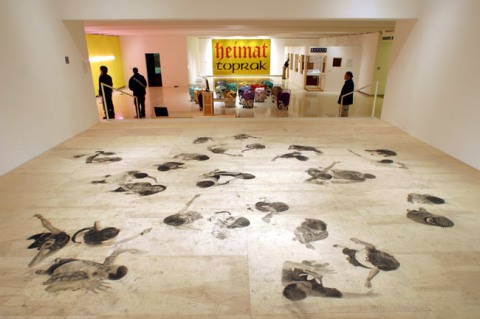
http://www.pbs.org/art21/slideshow/popup.php?slide=1406
"Charcoal Dance Floor"
1996-2002
Unfixed charcoal drawings on birch panels, dimensions variable. A highly detailed floor drawing of young clubgoers that slowly disappeared as the shoes of gallery visitors scuffed it
“A word cannot be reduced to a thing, a functionality, or a practicality. It claims many different things, but nothing in particular. It can be precisely about this and also precisely about that—and that and that—many things at one time.”
Homework + Supplies due 04.14.10
1. Go see "Iannis Xenakis: Composer, Architect, Visionary" and "Sea Marks" at The Drawing Center. We won't be discussing this until 04.14.10, but the exhibition closes 04.08.10.
2. Three ideas for final project: Drawing Time. Have sketches and notes, be prepared to discuss.
3. Supplies: We have a musician coming next week, bring charcoal and other materials to draw him while he plays.
2. Three ideas for final project: Drawing Time. Have sketches and notes, be prepared to discuss.
3. Supplies: We have a musician coming next week, bring charcoal and other materials to draw him while he plays.
Wednesday, March 31, 2010
Homework + Supplies due 04.07.10
Finish your Giveaway and Collaboration projects. Bring in both, along with your in-class model drawings, and be prepared for a long and productive crit day.
Friday, March 26, 2010
Homework + Supplies due 03.31.10
1. Progress on Giveaway and Collaboration projects.
2. Read "New Weapons in Europe's Culture Wars." Be prepared to discuss in class.
3. Go see "Iannis Xenakis: Composer, Architect, Visionary" and "Sea Marks" at The Drawing Center. We won't be discussion this until 04.14.10, but the exhibition closes 04.08.10.
4. Supplies: Please bring in any materials you need to work on both your Collaboration and Giveaway projects.
*Both The Giveaway and Collaboration projects are due 04.07.10.
Monday, March 22, 2010
Extra Credit: Joan Jonas lecture this Wed. 7pm
*Extra credit -- go to the lecture and write 3 paragraphs about it in your sketchbook.
 Translations: Joan Jonas Artist Talk with Linda Nochlin
Moderated by Jovana Stokić
Wednesday, March 24, 2010 at 7pm
Free and open to the public
Location One • 26 Greene Street NYC 10013 • +1 212.334.3347 • http://location1.org
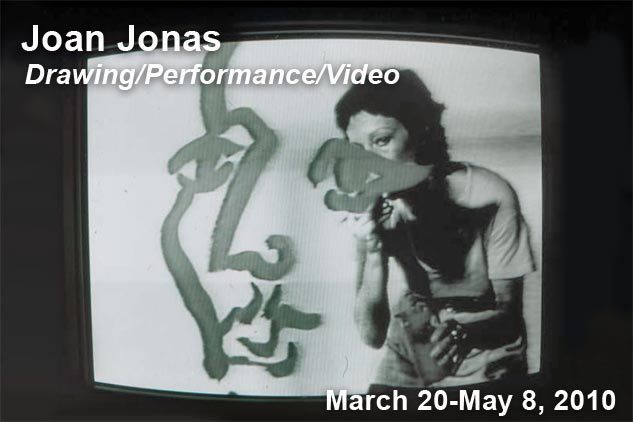
Location One is proud to present Drawing/Performance/Video, a new exhibition by Joan Jonas that highlights the role of drawing in the artist's performance and video work, on view through May 8, 2010.
In conjunction with this exhibition, Location One will host two evenings of conversation with Jonas.
March 24 at 7pm: Translations
Linda Nochlin speaks with Joan Jonas, moderated by Jovana Stokić
Beyond the current heated discussion of museums' interest in preserving the legacy of performance art of the 1970s, this talk will focus on another issue central to performance art: the representation of the feminine self from the 1970s till today. It brings together preeminent feminist art historian Linda Nochlin, and visionary artist Joan Jonas, contemporaries who, in different ways, have worked for more than five decades on debunking the myths of the essential female subject. The moderator of this encounter, art historian and curator Jovana Stokić, has written a PhD dissertation based on these quests in both art and art history. It is a critical intervention into the notion of contemporary femininity in representation by tracing the ways in which the genre of self-portraiture became the principal constituent of a specific, feminine artistic identity. This talk will discuss the strategy of performative reading that hopes to show how the representation of the body is constructed as a site of subjectivity for a particular artist–Joan Jonas. It will offer analysis of Jonas's works that focus on the notion of feminine self-representation: from her early video performances to her later works. It will shed light on Jonas's articulation of the artistic self in representation, and her purposeful evocation of feminine beauty in performance.
Please also join us
Thursday, April 8th at 7 pm
Bonnie Marranca, Founder and Publisher of PAJ, A Journal of Performance and Art, and Claire MacDonald, Director, International Centre for Fine Arts Research, University of the Arts London/Central St. Martins speak with Joan Jonas.
Joan Jonas is a pioneer of video-performance art. Her experiments and productions in the late 1960s and early 1970s were essential to the formulation of the genre. Threads of Jonas's influence can be found in many genres; from performance and video to conceptual art and theater.
Jonas has worked with composers such as Alvin Lucier and Jason Moran to develop video-performance works. Her work continues to explore the relationship of digital media to performance.
Jonas has had major retrospectives at the Stedelijk Museum, Amsterdam (1994), and Galerie der Stadt Stuttgart, Germany (2000), and was represented in Documenta V, VI, VII and XI in Kassel, Germany. In 2004, the Queens Museum of Art presented Joan Jonas: Five Works, the first major exhibition of the Joan Jonas's work in a New York museum. The exhibition included a selection of the artist's most significant installations, a video room, and a survey of Jonas' drawings, photographs, and sketchbooks.
The first installation and performance of Jonas's Reading Dante was at the 2008 Biennale of Sydney. Later that year Jonas performed the work at the Yokohama Triennale, and also performed a reading at The Isabella Stewart Gardner Museum in Boston. Jonas was featured in the International Pavilion of the 2009 Venice Biennale where she installed Reading Dante II. Most recently, the artist presented Reading Dante II at the Performing Garage in New York as part of Performa '09, and selected elements of this performance are featured in Reading Dante III at Yvon Lambert New York. Also at the Museum of Modern Art, through May 31, 2010, Performance 7: Mirage, which is a reimagining of the groundbreaking performance originally created in 1976. In 2009 Jonas was awarded the Guggenheim's first annual Lifetime Achievement Award.
Joan Jonas is represented by Yvon Lambert Gallery, and was Senior Artist in Residence at Location One in 2008-09.
Linda Nochlin, a Professor and art historian, is considered to be a leader in feminist art history studies. In 1971, the magazine ArtNews published an essay whose title posed a question that would spearhead an entirely new branch of art history. The essay, "Why Have There Been No Great Women Artists?," explores possible reasons why "greatness" in artistic accomplishment has been reserved for male "geniuses" such as Michelangelo. Nochlin argues that general social expectations against women seriously pursuing art, restrictions on educating women at art academies, and "the entire romantic, elitist, individual-glorifying, and monograph-producing substructure upon which the profession of art history is based" have systematically precluded the emergence of great women artists. Nochlin has also been involved in publishing other essays and books including Women, Art, and Power: And Other Essays (1988), The Politics of Vision: Essays on Nineteenth-Century Art and Society (1989), Women in the 19th Century: Categories and Contradictions (1997), and Representing Women (1999). Nochlin was the co-curator of a number of landmark exhibitions exploring the history and achievements of female artists. "Women Artists: 1550-1950" (with Anne Sutherland Harris) opened at the Los Angeles County Museum of Art in 1976. "Global Feminisms" (with Maura Reilly) opened at the Brooklyn Museum in 2007. Nochlin received her BA from Vassar College, an MA in English from Columbia University, and her PhD in the history of art from the Institute of Fine Arts at New York University in 1963. Besides feminist art history, she is best known for her work on Realism, specifically on Courbet. After working in the art history departments at Yale University, the Graduate Center of the City University of New York (with Rosalind Krauss), and Vassar College, Nochlin took a position at the Institute of Fine Arts, where she continues to teach.The thirty-year anniversary of Nochlin's query motivated a conference at Princeton University in 2001. The book associated with the conference, "Women artists at the Millennium", that hosts Nochlin's new essay ""Why Have There Been No Great Women Artists?" Thirty Years After", and in which art historians discuss the innovative work of contemporary artists in the light of the legacies of thirty years of feminist art history, appeared in 2006.
Belgrade-born, New York-based art historian and critic Jovana Stokić holds a PhD from the Institute of Fine Arts at the New York University. Her dissertation, titled "The Body Beautiful: Feminine Self-Representations 1970 - 2007," analyzes works of several women artists — Marina Abramovic, Martha Rosler, Joan Jonas — since the 1970s, particularly focusing on the notions of self-representation and beauty. Jovana has been writing art criticism for several years, and has curated several thematic exhibitions and performance events in the US, Italy, Spain and Serbia. Jovana was a fellow at the New Museum of Contemporary Art, New York, a researcher at the Whitney Museum of American Art, New York, and the curator of the Kimmel Center Galleries, New York University. She has most recently written an essay for Marina Abramović's MoMA exhibition catalogue.
NY State Council on the Arts
ABOUT LOCATION ONE
Based in the Soho arts district of New York, Location One is an independent, non-profit organization dedicated to fostering new forms of creative expression and cultural exchange through exhibitions, residencies, performances, public lectures and workshops. Traditionally focused on technological experimentation and new media, Location One's residencies and programs have favored social and political discourse and dialogue, and acted as a catalyst for collaborations. With a unique environment providing individualized training, support, and guidance to each artist, as well as exposure for their creations and collaborations, Location One continues to nurture the spirit of experimentation that it considers the cornerstone of its mission.
Moderated by Jovana Stokić
Wednesday, March 24, 2010 at 7pm
Free and open to the public
Location One • 26 Greene Street NYC 10013 • +1 212.334.3347 • http://location1.org
Location One is proud to present Drawing/Performance/Video, a new exhibition by Joan Jonas that highlights the role of drawing in the artist's performance and video work, on view through May 8, 2010.
In conjunction with this exhibition, Location One will host two evenings of conversation with Jonas.
March 24 at 7pm: Translations
Linda Nochlin speaks with Joan Jonas, moderated by Jovana Stokić
Beyond the current heated discussion of museums' interest in preserving the legacy of performance art of the 1970s, this talk will focus on another issue central to performance art: the representation of the feminine self from the 1970s till today. It brings together preeminent feminist art historian Linda Nochlin, and visionary artist Joan Jonas, contemporaries who, in different ways, have worked for more than five decades on debunking the myths of the essential female subject. The moderator of this encounter, art historian and curator Jovana Stokić, has written a PhD dissertation based on these quests in both art and art history. It is a critical intervention into the notion of contemporary femininity in representation by tracing the ways in which the genre of self-portraiture became the principal constituent of a specific, feminine artistic identity. This talk will discuss the strategy of performative reading that hopes to show how the representation of the body is constructed as a site of subjectivity for a particular artist–Joan Jonas. It will offer analysis of Jonas's works that focus on the notion of feminine self-representation: from her early video performances to her later works. It will shed light on Jonas's articulation of the artistic self in representation, and her purposeful evocation of feminine beauty in performance.
Please also join us
Thursday, April 8th at 7 pm
Bonnie Marranca, Founder and Publisher of PAJ, A Journal of Performance and Art, and Claire MacDonald, Director, International Centre for Fine Arts Research, University of the Arts London/Central St. Martins speak with Joan Jonas.
Joan Jonas is a pioneer of video-performance art. Her experiments and productions in the late 1960s and early 1970s were essential to the formulation of the genre. Threads of Jonas's influence can be found in many genres; from performance and video to conceptual art and theater.
Jonas has worked with composers such as Alvin Lucier and Jason Moran to develop video-performance works. Her work continues to explore the relationship of digital media to performance.
Jonas has had major retrospectives at the Stedelijk Museum, Amsterdam (1994), and Galerie der Stadt Stuttgart, Germany (2000), and was represented in Documenta V, VI, VII and XI in Kassel, Germany. In 2004, the Queens Museum of Art presented Joan Jonas: Five Works, the first major exhibition of the Joan Jonas's work in a New York museum. The exhibition included a selection of the artist's most significant installations, a video room, and a survey of Jonas' drawings, photographs, and sketchbooks.
The first installation and performance of Jonas's Reading Dante was at the 2008 Biennale of Sydney. Later that year Jonas performed the work at the Yokohama Triennale, and also performed a reading at The Isabella Stewart Gardner Museum in Boston. Jonas was featured in the International Pavilion of the 2009 Venice Biennale where she installed Reading Dante II. Most recently, the artist presented Reading Dante II at the Performing Garage in New York as part of Performa '09, and selected elements of this performance are featured in Reading Dante III at Yvon Lambert New York. Also at the Museum of Modern Art, through May 31, 2010, Performance 7: Mirage, which is a reimagining of the groundbreaking performance originally created in 1976. In 2009 Jonas was awarded the Guggenheim's first annual Lifetime Achievement Award.
Joan Jonas is represented by Yvon Lambert Gallery, and was Senior Artist in Residence at Location One in 2008-09.
Linda Nochlin, a Professor and art historian, is considered to be a leader in feminist art history studies. In 1971, the magazine ArtNews published an essay whose title posed a question that would spearhead an entirely new branch of art history. The essay, "Why Have There Been No Great Women Artists?," explores possible reasons why "greatness" in artistic accomplishment has been reserved for male "geniuses" such as Michelangelo. Nochlin argues that general social expectations against women seriously pursuing art, restrictions on educating women at art academies, and "the entire romantic, elitist, individual-glorifying, and monograph-producing substructure upon which the profession of art history is based" have systematically precluded the emergence of great women artists. Nochlin has also been involved in publishing other essays and books including Women, Art, and Power: And Other Essays (1988), The Politics of Vision: Essays on Nineteenth-Century Art and Society (1989), Women in the 19th Century: Categories and Contradictions (1997), and Representing Women (1999). Nochlin was the co-curator of a number of landmark exhibitions exploring the history and achievements of female artists. "Women Artists: 1550-1950" (with Anne Sutherland Harris) opened at the Los Angeles County Museum of Art in 1976. "Global Feminisms" (with Maura Reilly) opened at the Brooklyn Museum in 2007. Nochlin received her BA from Vassar College, an MA in English from Columbia University, and her PhD in the history of art from the Institute of Fine Arts at New York University in 1963. Besides feminist art history, she is best known for her work on Realism, specifically on Courbet. After working in the art history departments at Yale University, the Graduate Center of the City University of New York (with Rosalind Krauss), and Vassar College, Nochlin took a position at the Institute of Fine Arts, where she continues to teach.The thirty-year anniversary of Nochlin's query motivated a conference at Princeton University in 2001. The book associated with the conference, "Women artists at the Millennium", that hosts Nochlin's new essay ""Why Have There Been No Great Women Artists?" Thirty Years After", and in which art historians discuss the innovative work of contemporary artists in the light of the legacies of thirty years of feminist art history, appeared in 2006.
Belgrade-born, New York-based art historian and critic Jovana Stokić holds a PhD from the Institute of Fine Arts at the New York University. Her dissertation, titled "The Body Beautiful: Feminine Self-Representations 1970 - 2007," analyzes works of several women artists — Marina Abramovic, Martha Rosler, Joan Jonas — since the 1970s, particularly focusing on the notions of self-representation and beauty. Jovana has been writing art criticism for several years, and has curated several thematic exhibitions and performance events in the US, Italy, Spain and Serbia. Jovana was a fellow at the New Museum of Contemporary Art, New York, a researcher at the Whitney Museum of American Art, New York, and the curator of the Kimmel Center Galleries, New York University. She has most recently written an essay for Marina Abramović's MoMA exhibition catalogue.
NY State Council on the Arts
ABOUT LOCATION ONE
Based in the Soho arts district of New York, Location One is an independent, non-profit organization dedicated to fostering new forms of creative expression and cultural exchange through exhibitions, residencies, performances, public lectures and workshops. Traditionally focused on technological experimentation and new media, Location One's residencies and programs have favored social and political discourse and dialogue, and acted as a catalyst for collaborations. With a unique environment providing individualized training, support, and guidance to each artist, as well as exposure for their creations and collaborations, Location One continues to nurture the spirit of experimentation that it considers the cornerstone of its mission.
Wednesday, March 10, 2010
Is This a Drawing? A Collaboration between Parsons & The Drawing Center
This semester Parsons begins a joint project with the Drawing Center and we invite you to participate. The project will take place in three parts:
1. Lecture held 3/9/2010
2.The second occasion will be Brett Littman working with a small group of students on Tuesday, April 13th at 6:30 PM. The group will meet to engage in a broad and provcative conversation about what drawing is and can be. Questions and surprising points of view are encouraged. Fifteen students from across Parsons will be chosen to participate. Students of any year and any department may apply.
TO APPLY:
-Send up to 10 images on a DVD, along with
-A brief statement (up to one page) that addresses the question: how does drawing fit into your work?
Applications are due MONDAY MARCH 21 to Lauren Redniss. You can either drop off the application to Lauren Redniss at the Illustration office, 2 West 13th Street, 8th floor, or by email at rednissl@newschool.edu.
EDIT: I emailed Lauren, and she says if you apply via email, you can submit images either by posting them to a website or a Flickr page (I would try to link them to a specific batch or page if you use your Flickr for sharing images outside your work) and sending them the link, or you can attach them as jpgs. Jpgs shouldn't be too large (dimension-wise or MB-wise) to open, but should be high enough resolution to be clearly projected.
3. The third meetings will be individual critiques at the Drawing Center. Students will bring their work for a meeting about his or her work with Brett Littman and a Drawing Center curator in the style of the Drawing Center's artist "Viewing program". Students will make these appointments with the Drawing Center at a mutually agreed upon date.
Homework + supplies due 03.24.10
1. Three written and sketched ideas for Giveaway project.
2. Read "New Weapons in Europe's Culture Wars." Be prepared to discuss in class.
3. Go see "Iannis Xenakis: Composer, Architect, Visionary" and "Sea Marks" at The Drawing Center. We won't be discussion this until 04.14.10, but the exhibition closes 04.08.10.
4. Supplies: Please bring in all of the drawings you have so far from the Collaboration project. We are going to have a work-in-progress discussion. Bring what you need to work from the models (our dancers will be returning) or on The Giveaway project or a bit of both.
*Both The Giveaway and Collaboration projects are due 04.07.10.
The Giveaway (due 04.07.10)
A "giveaway" is a noun with several meanings: an unintentional revelation or betrayal, something given away free / the act of giving something away free, or a program on which prizes are given away.
Expand on the multiple meanings of giveaway by creating a drawing-based work of art that can be reproduced and given away. Examples include photocopies, zines, CDs, DVDs, posters, leaflets, cards, stickers, etc. You’ll need a minimum of 30 copies. Consider where and how the work will be installed (Is it handed out on the street? Left somewhere in a box? Stuck to walls throughout the city?), and what happens when all of the pieces are taken.
References
The Yes Men's Fake New York Times
Adam Neate
The Audacity of Desperation exhibition
Wednesday, March 3, 2010
Homework + supplies due 03.10.10
1. Collaboration project.
2. Post photos of your Narrative projects and in-class work to our flickr page.
3. Go to the lecture "From Lascaux Caves to Audocad: A History of Drawing" by Brett Littman, Executive Director of the Drawing Center.
Tuesday March 9, 2010
6:30 pm – 8:30 pm
The New School
66 West 12th Street
Room A510
Answer the following in your sketchbook and post here as blog comments:
-Which artwork(s) expanded your idea of what drawing could be?
-Were there any pieces that you disagreed with (you felt were not drawing)?
-What was your favorite artwork presented?
4. Supplies:
Bring at least 2 good sheets of paper to work on and a variety of drawing media (color is optional). We will be working from the model.
Crit Groups
Group A
Roland
Joanne
Peter
Maria
Group B
Olivia
Maura
Andrea
Heather
Group C
Shawn
Warra
Day
Laura
Group D
Bunny
A Gyong
Emma
Lisandra
Roland
Joanne
Peter
Maria
Group B
Olivia
Maura
Andrea
Heather
Group C
Shawn
Warra
Day
Laura
Group D
Bunny
A Gyong
Emma
Lisandra
Tuesday, March 2, 2010
Visiting Artist Lectures Spring 2010
Hi class,
Below is the schedule of the visiting artist lectures for this semester. Click through on the artists' names to access their websites. Note that there have been some changes from the original calendar (shown on the posters near the elevators) due to flight cancellations, snow days, etc.
All artists speak on Wednesdays, 3 pm to around 4:30 pm in the Kellen Auditorium at 66 Fifth Avenue (the building on the corner with the downward-facing block letters and large glass windows). If you come in through the 5th Avenue entrance, the auditorium is on the first floor, to your left, across from the elevators.

3/3 Huma Bhabha
3/10 Byron Kim (replacing Victor Zamudio Taylor)
3/24 Lin and Lam
3/31 John Miller
4/7 Martha Wilson
4/14 Sara VanDerBeek
4/21 Kurt Kauper
4/28 Hank Willis Thomas
5/5 Marlene McCarty
Kurt Kauper, "Cary Grant #3", 2003
Monday, March 1, 2010
Drawing lecture at Parsons

Brett Littman, Executive Director of the Drawing Center
The kick-off event to introduce a collaboration between The Drawing Center and Parsons
Free and Open to the Public!
Tuesday March 9, 2010
6:30 pm – 8:30 pm
The New School
66 West 12th Street
Room A510
Brett Littman, Executive Director of The Drawing Center, will present a lecture entitled "From Lascaux Caves to Autocad." A wide range of issues will be explored, including: What is the relevance of drawing in contemporary culture? How does one define the activity of drawing today? What does it mean to expand the definition of drawing to encompass architecture, design, music, science, dance? This talk will highlight the curatorial decisions that have shaped the Drawing Center’s upcoming programming.
Established in 1977, The Drawing Center is the only fine arts institution in the United States to focus solely on the exhibition of drawings. Its programmatic philosophy is investigative in nature and promotes a multi-faceted understanding of drawing through exhibitions, publications, educational and public programs, and the Viewing Program for emerging artists. The Drawing Center is located at 35 Wooster Street in New York City.
-Image: Agnes Barley, Untitled Collage, 2009. Acrylic on cut paper, 15 x 16 inches. Photo by Cary Whittier. Courtesy of the artist. From the current exhibition "Sea Marks" at The Drawing Center.
Wednesday, February 24, 2010
Homework + supplies due 03.03.10
1. Finish your Narrative project. Figure out where and how to display it (wall? floor? installation space?), and bring any necessary supplies.
2. Work on your Collaboration project.
3. Bring in your Narrative project AND your in-class figure drawings, we'll be looking at both.
2. Work on your Collaboration project.
3. Bring in your Narrative project AND your in-class figure drawings, we'll be looking at both.
Wednesday, February 17, 2010
More Collaborations

Newton and Helen Mayer Harrison (often referred to simply as "the Harrisons")
Gilbert & George
Homework + supplies due 02.24.10
1. Work on your Narrative project (due 03.03.10). Bring in progress next week: materials tests, sketches, and the beginnings of your final piece. This is due in 2 weeks, so get as much done as possible.
2. Meet with your partner, and get started on your Collaboration.
3. Supplies: Bring in materials to work on your Collaboration. After that, you have the option of working from the models again, or working on your Narrative. Bring necessary supplies for whichever you decide.
2. Meet with your partner, and get started on your Collaboration.
3. Supplies: Bring in materials to work on your Collaboration. After that, you have the option of working from the models again, or working on your Narrative. Bring necessary supplies for whichever you decide.
Subscribe to:
Posts (Atom)