The key to many successful time-based artworks is documentation. Think about how you are going to stage it, and what exactly you want the audience to see: Is it an animation? Is it a live performance? Are you showing only evidence from a past performance? Are we watching a video of the performance?
Please plan in advance. Reserve an installation room if you need it, and consider how, when, where and what equipment (camera, TV, DVD player) you will need. If your performance needs to be videotaped, you must arrange for one of your classmates to tape it, including reserving the video camera and tripod.
REFERENCES

Carolee Schneeman
http://www.caroleeschneemann.com
Up to and Including Her Limits 1973-76
Performance. live video relay. Crayon on paper, rope and harness suspended from ceiling. The Kitchen. NYC.
Up To And Including Her Limits was the direct result of Pollock's physicalized painting process....
I am suspended in a tree surgeon's harness on a three-quarter-inch manila rope, a rope which I can raise or lower manually to sustain an entranced period of drawing– my extended arm holds crayons which stroke the surrounding walls, accumulating a web of colored marks. My entire body becomes the agency of visual traces, vestige of the body's energy in motion."
Interior Scroll 1975
Performance.
Performed in East Hampton,NY and at the Telluride Film Festival, Colorado. Schneemann ritualistically stood naked on a table, painted her body with mud until she slowly exracted a paper scroll from her vagina while reading from it.
"I thought of the vagina in many ways-- physically, conceptually: as a sculptural form, an architectural referent, the sources of sacred knowledge, ecstasy, birth passage, transformation. I saw the vagina as a translucent chamber of which the serpent was an outward model: enlivened by it's passage from the visible to the invisible, a spiraled coil ringed with the shape of desire and generative mysteries, attributes of both female and male sexual power. This source of interior knowledge would be symbolized as the primary index unifying spirit and flesh in Goddess worship."
Paul McCarthy
http://www.ubu.com/film/mccarthy.html
Black and White Tapes derive from a series of performances Paul McCarthy undertook in his Los Angeles studio from 1970 to 1975. Conceived for the camera and performed alone or with only a few people present, these short performances use video to articulate both monitor and studio space. In the first excerpt, McCarthy paints a white line on the floor with his face, dragging his body from one end of the studio to the other. In doing so, McCarthy performs a recognizable formal gesture - drawing a white line. Radically inserting his body into the painting process may have been intended as a parody of prevailing minimalist sensibilities.
Richard Long
http://www.richardlong.org/

Janine Antoni
Loving Care, Butterfly Kisses, Touch, and Moor
http://www.pbs.org/art21/artists/antoni/clip1.html#
Janine Antoni was born in Freeport, Bahamas in 1964. She received her BA from Sarah Lawrence College in New York, and earned her MFA from the Rhode Island School of Design in 1989. Antoni’s work blurs the distinction between performance art and sculpture. Transforming everyday activities such as eating, bathing, and sleeping into ways of making art, Antoni’s primary tool for making sculpture has always been her own body. She has chiseled cubes of lard and chocolate with her teeth, washed away the faces of soap busts made in her own likeness, and used the brainwave signals recorded while she dreamed at night as a pattern for weaving a blanket the following morning. In the video, “Touch,” Antoni appears to perform the impossible act of walking on the surface of water. She accomplished this magician’s trick, however, not through divine intervention, but only after months of training to balance on a tightrope that she then strung at the exact height of the horizon line. Balance is a key component in the related piece, “Moor,” where the artist taught herself how to make a rope out of unusual and often personal materials donated by friends and relatives. By learning to twist the materials together so that they formed a rope that was neither too loose nor too tight, Antoni created an enduring life-line that united a disparate group of people into a unified whole.
Ward Shelley, Jesse Bercowetz, and Matt Bua
Drawing While Driving
http://www.zingmagazine.com/issue19/heinlein.html
http://www.overcoat.org/TruckDrawing/nav.html
Matt, Ward, and Jesse take turns frantically driving each other around NYC in a U-Haul truck at night. One drives fast, erratically, hitting potholes, swerving, speeding. The other is suspended in the rear of the truck in a tree-climbing harness, costumed as a monster, rock star, or robot, armed only with a large black marker, attempting to make a drawing on the paper-covered interior walls of the truck. The resulting drawing is a mapping of body and drawing tool fighting for control in constantly shifting conditions of motion and inertia.
Next: A truck is outfitted with a drawing device on its underside. Each artist takes a turn using it to create an image, directing a team of truck lifters as to which direction and with what pressure to move the truck. A camera and a contact microphone are recording, amplifying, and outputting live feed.
Finally: The front end of the truck is outfitted with a drawing appendage and camera. A passenger riding in the back of the truck directs the driver of the vehicle via walkie-talkie, viewing the drawing in progress from a monitor and steering the driver towards its realization/destination.
Brian Collier
http://briandcollier.com/html/hmp/hmpframes/hmpFrameset-3.htm
Human Movement Patterns
Waxed archival digital prints, red quilting pins, artist made frames, hand-made book, 2002
Tracking an individual's regular movements can be both uncomfortably intimate and frigidly anonymous. For this project I create a series of map-portraits based on several individual's habitual weekly travels. The appearance of scientific objectivity in the finished map-portraits works in direct opposition to the fact that I personally know all the individuals represented. Furthermore, the initial maps were made by those individuals themselves, rather than an outside observer. Most of the participants reported that this self-surveillance was slightly disturbing. There is an underlying intimacy, evoked only subtly, when the viewer notices the flesh-like quality of the hand-waxed paper or the use of only first names of participants.
Jeremy Wood
GPS drawing
http://www.gpsdrawing.com/gallery/land/meridians.html
A walk though London along the quote: “It is not down in any map; true places never are.” -Herman Melville, Moby Dick
Jennifer Allora and Guillermo Calzadilla
http://media.walkerart.org/973480.jpg
http://www.pbs.org/art21/slideshow/popup.php?slide=1406
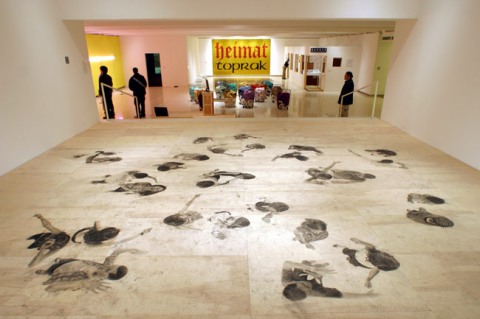
"Charcoal Dance Floor"
1996-2002
Unfixed charcoal drawings on birch panels, dimensions variable. A highly detailed floor drawing of young clubgoers that slowly disappeared as the shoes of gallery visitors scuffed it
“A word cannot be reduced to a thing, a functionality, or a practicality. It claims many different things, but nothing in particular. It can be precisely about this and also precisely about that—and that and that—many things at one time.”

No comments:
Post a Comment